Case Study 01 · Platform Redesign
A $500M client relationship, a collapsing legacy platform, and a 12-month deadline to rebuild it entirely — with a shrinking team.
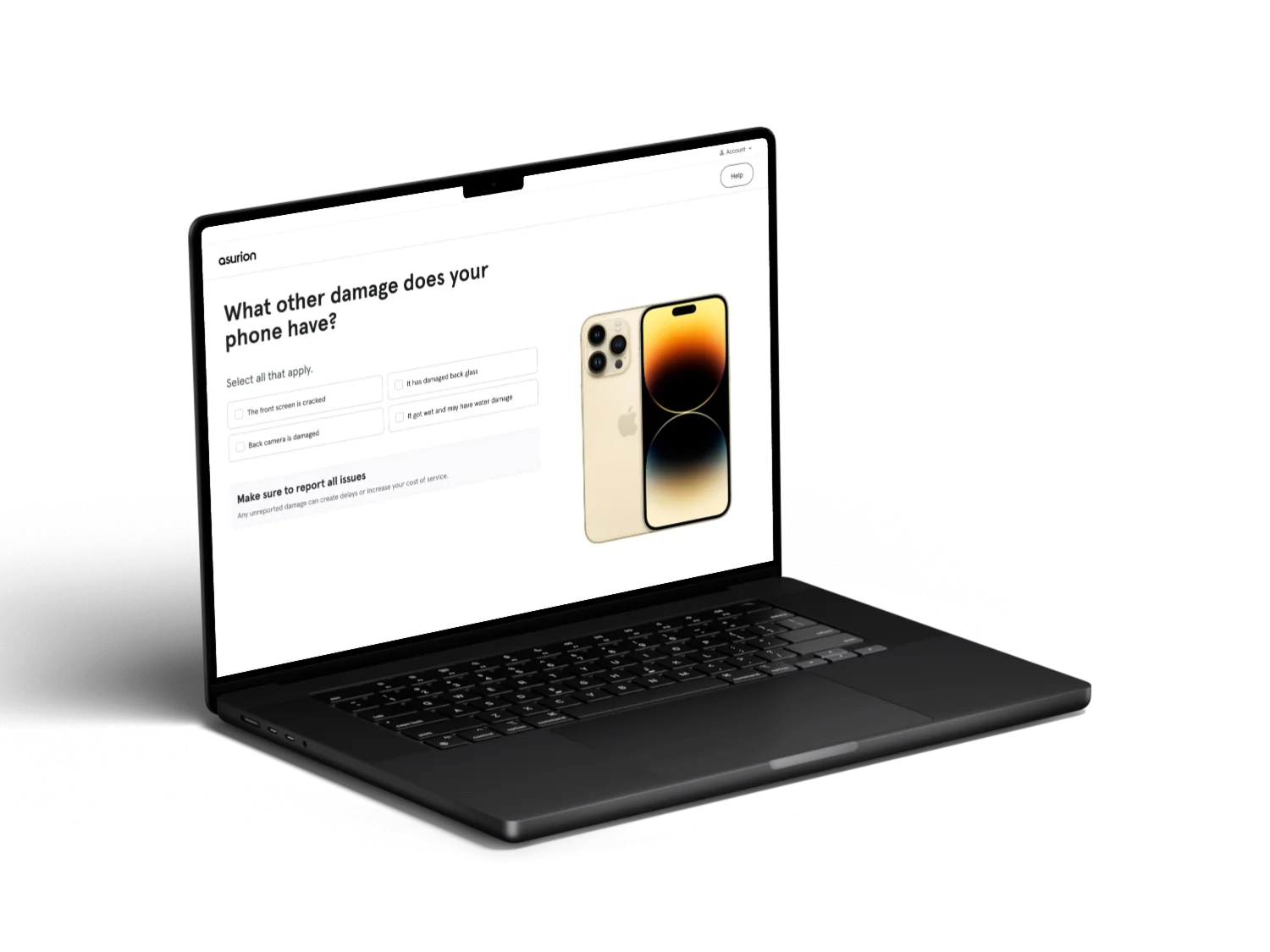
Asurion's Mobility claims platform — the system that powers device repair and replacement for millions of Verizon, AT&T, and Amazon customers — had accumulated years of technical debt. One-off fixes, disjointed workflows, and mounting instability had made it difficult to maintain, nearly impossible to scale, and a growing liability with our largest enterprise client.
With a $500M client relationship at risk and a hard deadline on the calendar, I was brought in to lead the full UX redesign and platform migration. Over 12 months, I directed a cross-functional team of 37 — navigating mid-project scope expansion, two rounds of layoffs, and the pressures of a high-visibility client pilot — and delivered a platform that now serves 20M+ users annually.
We made a deliberate strategic call early on: launch to Verizon first. With the highest volume of users, the most complex user paths, and the greatest number of edge cases, Verizon was the right MVP — if the platform could handle Verizon at scale, it could handle anyone. AT&T and Amazon would follow once the foundation proved itself in the most demanding environment possible.
Years of patches had introduced bugs and performance gaps that made the platform unreliable — and difficult to build on top of.
Bringing on new clients required 16+ weeks. That wasn't a product problem — it was an organizational constraint we had to design our way out of.
Mid-project, we inherited two additional product domains. The timeline didn't change. The team didn't grow. The work did.
Two rounds of layoffs cut into the design team during the project. I restructured roles and workflows to preserve momentum without burning anyone out.
A top client was losing confidence in the experience. Every week without visible progress was a week closer to losing a $500M relationship — and everyone in the room knew it.
My approach was rooted in one belief: that design leadership in a high-stakes environment isn't just about the UX — it's about creating the conditions for the work to happen at all. That meant building the right team structure, managing the cross-functional relationships, and making operational improvements that would outlast the project itself.
Built a tiered design structure where senior ICs handled complex UX problems and junior designers owned edge cases with direct oversight. This kept quality high while distributing the workload intelligently.
Orchestrated 32+ stakeholders across design, product, engineering, legal, and compliance — navigating MFE-specific constraints and competing priorities. Created shared decision-making frameworks and clear risk framing to keep alignment without constant escalation.
Synthesized findings across FullStory, PowerBI, CSAT data, and user interviews. Identified key drop-off points tied to flow confusion and restructured the entire claim process — despite heavy stakeholder resistance. Piloted changes with Google to stress-test before broader rollout.
Replaced a slow PowerPoint-based legal review process with a Figma-native workflow — complete with reusable logic files, feature flags, and Loom training for reviewers. Review time was cut in half. The process was adopted org-wide.
"Early advocacy for design resources is not optional — it's critical. Strong cross-functional relationships unlock what would otherwise be unblockable problems."
In partnership with the design systems team, we created flexible card components with toggled customizations across multiple client configurations. These components didn't just solve this project's needs — they're now in active use across Asurion's Devices, Trade-in, Home Agent tools, and Asurion.com.
When a design initiative creates infrastructure that the whole organization adopts, that's when you know it was done right.
Resource advocacy is design leadership. Fighting for headcount and tooling isn't overhead — it's how you protect the work's integrity under pressure.
Cross-functional trust is the real output. The platform launched, but the more durable win was a set of relationships and processes that kept functioning after the project ended.
Clear and consistent communication is your most powerful tool. In a high-stakes, multi-team environment, the leaders who communicated well — early, often, and with context — were the ones who kept momentum alive when everything else threatened to stall it.
Hands-on leadership builds trust faster than titles. Working alongside the team — not just directing from above — accelerated momentum and made the hard calls easier to land.
The Impact
Client onboarding time cut by more than half — a platform-level outcome that compresses time-to-revenue for every new partner going forward.
Fewer dev cycles, faster legal reviews, and reusable components eliminated recurring overhead that had been invisible but expensive.
The redesigned platform now underpins claims and repair experiences for Verizon, AT&T, and Amazon customers nationwide.
The platform stabilization restored confidence with Asurion's largest enterprise client and laid the foundation for continued AT&T expansion.
The legal review workflow transformation was adopted across the organization — the clearest signal that operational improvements had structural impact.
Migration delivered on schedule — through two rounds of layoffs and mid-project scope expansion. A testament to team structure, clear ownership, and relentless prioritization.